Rahasak (meaning “Secret” or “Whisper” in Sinhala) is a secure, end-to-end encrypted messaging platform designed to prioritize user privacy and trust. Unlike traditional messaging apps that rely on centralized servers for key distribution, Rahasak introduces a novel physical key exchange protocol, allowing users to establish trust offline before communicating.
Powered by Java and Apache Kafka, the system ensures high-throughput, real-time message routing without compromising security.
🚀 Key Features
- End-to-End Encryption (E2EE): All messages are encrypted on the sender’s device and can only be decrypted by the recipient. The server (Kafka) never sees the plaintext.
- Novel Physical Key Exchange: A unique protocol that mandates users to share public keys via an offline medium (e.g., QR code, USB, local network) to eliminate Man-in-the-Middle (MITM) attacks during the initial handshake.
- Real-Time Messaging: Utilizes an Apache Kafka cluster for low-latency, scalable, and reliable message routing and delivery.
- Zero-Knowledge Architecture: The messaging broker stores only encrypted data and has no access to user private keys.
🛠️ Tech Stack
- Language: Java (Core logic and application)
- Messaging Broker: Apache Kafka
- Encryption: Asymmetric Encryption (RSA 2048/4096-bit)
- Build Tools: Maven / Gradle
🏗️ Architecture
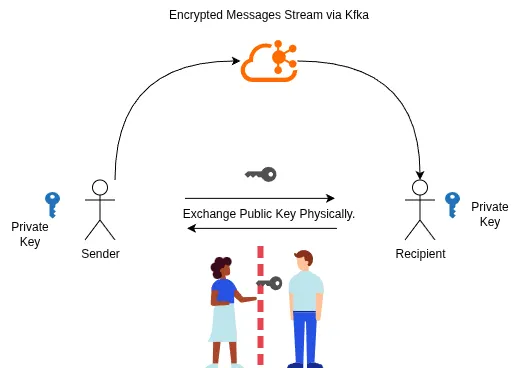
Rahasak operates on a decentralized trust model while using a centralized backbone for data transport.
- Client Application (Java): Handles key generation (Public/Private key pair), encryption/decryption, and UI.
- Key Exchange Phase: Users manually exchange Public Keys offline. This establishes a “Web of Trust” without relying on a central Key Authority.
- Message Transport (Kafka):
- Producers: Encrypt messages using the recipient’s Public Key and publish to a recipient’s Kafka topic.
- Consumers: Subscribe to their his own topic, receive the encrypted payload, and decrypt it using their Private Key.
📖 Usage Guide
Phase 1: Identity Creation & Key Exchange
Before messaging, you must establish a secure channel.
- Run the application. A unique RSA Key Pair (Public & Private) is generated locally.
- Export your Public Key (this does not contain sensitive data).
- Share this key with your intended contact via a physical/offline method (e.g., flash drive, QR code scan, or local file transfer).
- Import your contact’s Public Key into your local keystore.
Phase 2: Secure Messaging
- Compose a message.
- The app encrypts the text using the recipient’s Public Key.
- The encrypted packet is sent to the Kafka cluster.
- The recipient polls the Kafka topic, downloads the packet, and decrypts it using their Private Key.
🔒 Security Protocol
Rahasak uses Asymmetric Encryption (RSA).
The system relies on the mathematical relationship between keys:
- Ciphertext: The encrypted data sent over Kafka.
- Public Key: Shared offline and used strictly for Encryption.
- Private Key: Kept secret on the device and used strictly for Decryption.
By forcing the Public Key exchange to happen offline, Rahasak mitigates the risk of a compromised central server serving fake keys to intercept messages (a common vulnerability in centralized E2EE apps).
🔮 Future Roadmap
- Group Messaging facility
- Voice calls.
- Implementation of Hybrid Encryption (AES + RSA) for faster large-file transfers.
- Android/Mobile companion app.
👨💻 Author
Your Name
- Year: 2024 - 2026
- GitHub: github.com/sathindudezoysa